Geofencing: The Fleet Management Feature That Pays for Itself
GPS tracking has moved well past the days of simply pinning a vehicle on a map. For fleet managers running operations remotely and around the clock, the real value now lives in what the data does — automating labor records, securing assets, holding drivers to their routes, and giving customers accurate ETAs. That shift is why roughly two-thirds of commercial fleets now run some form of GPS tracking, and why adoption has climbed every year since 2018.
At the center of that value is one feature that quietly does more work than almost any other: geofencing. Btracking builds it into every platform, and once fleet managers see what it eliminates from their week, it’s rarely turned off.
What Is Geofencing?
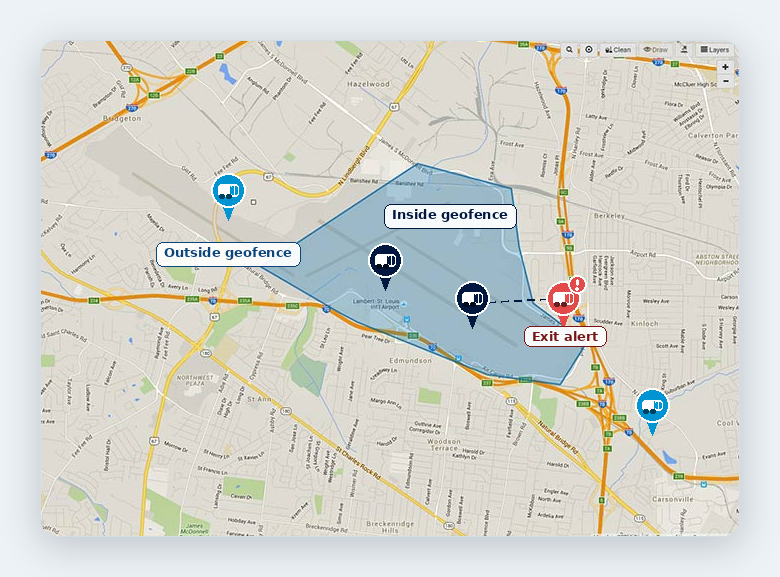
A geofence is a virtual boundary drawn around a real-world location — a job site, a depot, a customer address, a restricted zone, or an entire service territory. When a tracked vehicle or asset crosses that boundary, the system logs the event and sends an alert in real time.
You define the boundary directly on the map, and it can take almost any shape your operation needs. Btracking’s Easy Geofences™ let you draw a tight circle around a single job site or a multi-point polygon around a whole district, then attach rules to it: notify me on entry, on exit, on length of stay, or when a vehicle moves through it outside authorized hours. There’s no practical limit to how many you run — most fleets build them out for every recurring location they touch.
That’s the mechanical description. The reason geofencing matters is everything it automates once those boundaries are in place.
Four Ways Geofencing Earns Its Keep
Accurate arrival, departure, and customer ETAs. Service quality depends on crews reaching the job on time — and on being able to prove they did. A geofence generates instant arrival and departure notices plus total length of stay, so you know exactly when a vehicle reached a site, how long the work took, and when it left. That same live location data lets you give customers a real ETA instead of a four-hour window, which is consistently one of the top reasons operators adopt tracking in the first place. It also retires the paper time card at the job site entirely.
Automatic, dispute-proof labor records. Manual timesheets are slow, easy to pad, and impossible to verify after the fact. Geofence timestamps produce a clean, paperless log of when each crew arrived and left each job — the kind of record that ends he-said/she-said timesheet disputes in a single billing cycle. Fleets that put GPS timestamps behind their payroll routinely cut unplanned overtime by 15–25% within the first six months, simply by surfacing inflated hours and inefficient routing that were invisible before.
Theft protection and unauthorized-use alerts. Vehicle and equipment theft is not a shrinking problem. More than one million vehicles were stolen in the U.S. in 2023 — the highest total since 2008, according to the National Insurance Crime Bureau — with work vans, box trucks, and utility vehicles hit especially hard as used-truck values climb. Geofencing is a direct countermeasure: pair a boundary with an after-hours rule and you get an immediate alert the moment a vehicle moves when it shouldn’t, long before anyone notices it missing the next morning. Combined with driver ID (key fobs or your existing RFID/HID access cards), the same system flags unauthorized drivers and after-hours side jobs.
Route adherence and off-route alerts. Geofences aren’t only for destinations — they enforce the path between them. Assign the route a driver is supposed to follow, and the system alerts you the moment a vehicle strays off course. For delivery, service, and construction fleets, that keeps drivers on approved routes, protects high-value cargo, and cuts the fuel and hours lost to unauthorized detours.
Why This Matters More in 2026 Than It Did Five Years Ago
Geofencing used to be a premium add-on. Today it’s considered core infrastructure. The fleet telematics market is on track to roughly double — from about $10.4 billion in 2025 to nearly $22 billion by 2032 — and the fastest-growing slice is entry-level telematics built around exactly this trio: GPS tracking, geofencing, and basic diagnostics. As IoT sensors and AI-driven analytics get layered on top, geofence events increasingly feed predictive maintenance, fuel management, and automated compliance reporting rather than just triggering a text alert.
The financial case is just as clear. Well over two-thirds of fleets that install tracking report recouping their investment within the first year, and fleets running location-based automation like geofencing commonly see returns of 3:1 or better through reduced labor costs, recovered assets, and lower fuel spend.
The Bottom Line
Geofencing turns raw location data into automatic timekeeping, tighter security, and verifiable customer service — the operational work that used to eat a manager’s day. It’s no longer a “nice to have”; it’s one of the most direct paths to a measurable return on a fleet tracking system.
If you’d like to see how Btracking’s Easy Geofences™ and full fleet management platform fit your operation, call us at 1-475-999-2385, Monday–Friday, 9 AM–5 PM ET, or reach out at btracking.com. We’ve been building U.S.-based GPS tracking and telematics solutions for growing fleets since 2008.