ELD stands for Electronic Logging Device — a piece of hardware that connects to a commercial vehicle’s engine and automatically records driving time. Its job is to replace paper logbooks for the federal Hours of Service (HOS) rules that limit how long commercial drivers can drive.
What an ELD actually records
An ELD plugs into the vehicle’s diagnostic port and reads directly from the engine control module. It automatically captures:
- Engine on/off and whether the vehicle is moving
- Driving time, date, and location
- Miles driven and engine hours
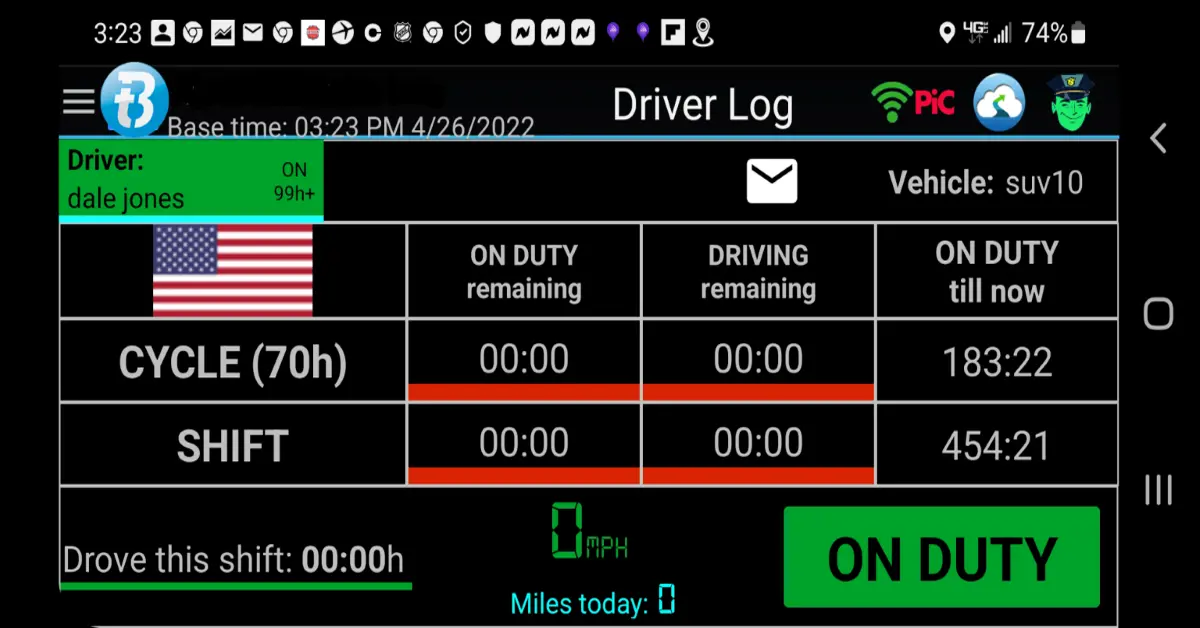
- Driver identification and duty status (driving, on-duty, off-duty, sleeper berth)
Because driving time is detected from the engine rather than typed in, it can’t be fudged the way paper logs could — that’s the point of the mandate.
Who is required to use one?
Under the FMCSA’s ELD rule, most commercial drivers who are required to keep records of duty status (RODS) must use an ELD. That generally means interstate drivers of vehicles over 10,000 lbs, vehicles placarded for hazmat, or vehicles designed for 9+ passengers (for hire).
Common exemptions include:
- Short-haul drivers operating within a 150 air-mile radius who return to base within the workday
- Driveaway-towaway operations where the vehicle being driven is the commodity
- Pre-2000 engines, which lack the electronic engine data an ELD needs
If you’re unsure whether your operation qualifies for an exemption, check the FMCSA’s current guidance — the details matter and carriers are audited on them.
ELD vs. GPS tracking — what’s the difference?
They overlap but aren’t the same thing. An ELD is a compliance device: its required job is recording duty status. A GPS fleet tracker is an operations device: live location, driver behavior, maintenance data, dispatch. Many fleets run one device (or one platform) that does both — the engine connection that powers an ELD provides the same data a fleet tracker uses.
What happens during a roadside inspection?
The driver transfers the ELD records to the inspector electronically (or shows the display). Violations of HOS limits — like exceeding the 11-hour driving limit or the 14-hour on-duty window for property carriers — are visible immediately, which is why fleets pair ELDs with alerts that warn drivers before they run out of hours.
Getting compliant without the headache
Btracking’s ELD solution runs on the same platform as our fleet GPS tracking, so compliance and day-to-day fleet visibility live in one login. If you run trucks and aren’t sure what you need, ask us — we’ll tell you plainly whether you need an ELD or just tracking.