
Table of Contents
14 min read
GPS Trackers for Farm Equipment: What to Fit on Trucks, Tractors, Implements and ATVs
Plug-in OBD-II trackers suit pickups; hardwired units with I/O inputs suit tractors and self-propelled machines; solar or long-life battery trackers suit…


What a farm GPS tracker does, and what it does not
A farm GPS tracker reports the location and movement of vehicles and equipment (along with ignition state, input events such as PTO on/off, and alerts) to a web platform; it does not steer, guide, map yield, control sections, or manage crop inputs.
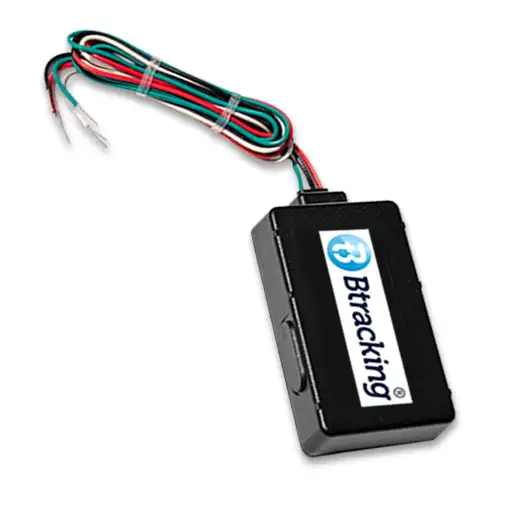
The BHW123 Hardwired Vehicle Tracker illustrates the category precisely: wired to power and ignition, it carries 2 digital inputs and 3 digital outputs that can be connected to monitor events such as door open/closed, lights on/off, and PTO on/off, and it reports location every minute when moving. That is the full scope, location, movement, and wired input events delivered to the platform.
ELD compliance (electronic logging of driver hours-of-service) is a separate regulatory product category and is not addressed by GPS asset trackers.
Pickups and farm trucks
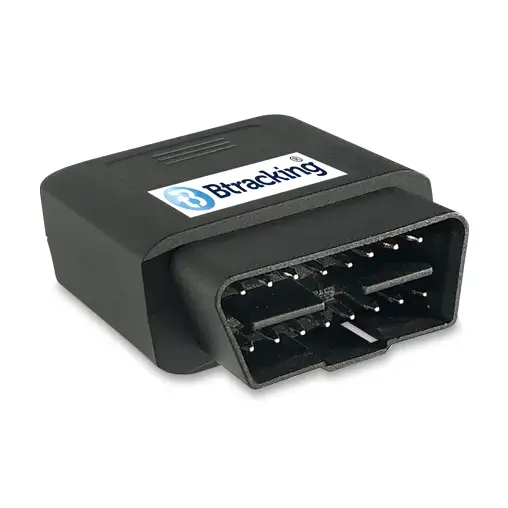
The BP50 Series Plugin Vehicle Tracker is the default choice for OBD-II-equipped pickups: at $69.99 it plugs directly into the port, reports location every minute while moving, and holds up to 1,000 messages in its internal buffer when cellular coverage lapses. Optional basic CANBus data (odometer, fuel level, battery voltage, coolant temperature, RPM, and VIN (vehicle dependent)) is available without changing hardware. Entry and exit alerts at defined job sites or customer locations are included in the platform.
Buy, the right tracker for the majority of OBD-II pickups at a straightforward price.
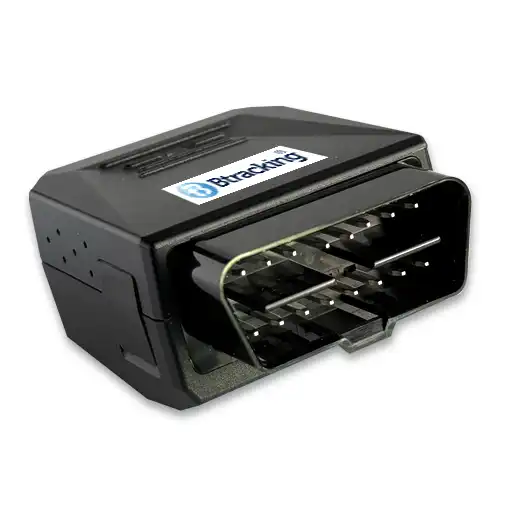
The BP304 Deluxe Plugin Vehicle Tracker occupies the same OBD-II form factor at $159.99, a $90 premium over the BP50 Series. That premium buys a substantially wider OBD data set: fuel level, DTC fault codes, RPM, VIN, seatbelt use, diesel particulate levels, DEF levels, throttle position, transmission fluid temperature, turn signals, and more. The device is also fully programmable and includes a built-in buzzer for audible driver warnings. Operators who will actively monitor engine diagnostics will use that capability; operators who need only location and basic vehicle data will not.
Consider, justified only when the operator will actively use the extended OBD data set; the BP50 Series is sufficient otherwise.
Free-device plan versus buying outright
As an alternative to buying either unit, a free plug-in tracker is available on a monthly plan. The terms are worth understanding before choosing:
- Free-device plan: $13.95/month on Standard plus a one-time activation fee ($20 for a plug-in without CANBus data; $25 with CANBus). The device may be a used unit, remains Btracking property, and ending the subscription requires returning it in proper working condition or paying an $85 buyout fee.
- Purchased device: $69.99 (BP50 Series) or $159.99 upfront, then $12.95/month on Standard. The device is owned outright, carries no return obligation, and the monthly rate is $1 less than the free-device plan.
Buying outright avoids the return obligation and saves $1/month on the subscription rate. Whether the upfront cost or the lower entry barrier matters more depends on the operator's capital position; neither option is declared the cheaper path overall without projecting a specific retention period.
A free device may be a used device and remains Btracking property for the life of the subscription. Budget the $85 buyout fee as a contingency if there is any possibility of cancelling before a replacement device is sourced.
Grain, livestock, and delivery trucks: BTPLUS and BTSTX gateways
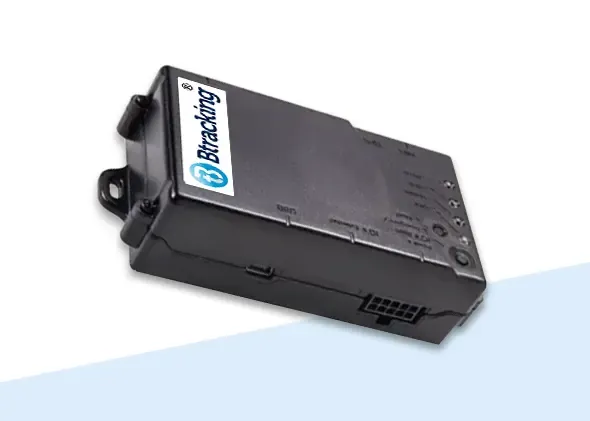
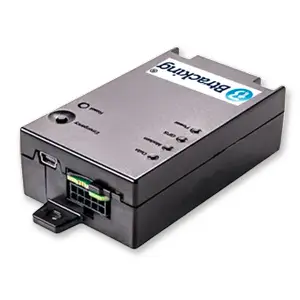
For working trucks that travel through areas with intermittent cellular coverage (grain haulers, livestock transports, rural delivery routes) the plug-in form factor is not the right architecture. The BTPLUS ProFleet Truck Tracker ($239.99) and the BTSTX ProFleet Truck Tracker ($219.99) are hardwired telematics gateways that store up to 5,000 events when out of coverage and transmit them automatically once connectivity is restored. Both units:
- Report location every minute when moving, every six hours when stopped (customizable)
- Read OBD-II and J1939 engine and vehicle diagnostic data
- Support automatic driver ID via RFID card or iButton, configurable to prevent unauthorized starts
- Execute a starter-kill command that prevents the vehicle from starting once it is stopped and the ignition is off
- Run exclusively on the ProFleet Platform
The BTPLUS and BTSTX differ in their I/O configurations, the BTSTX includes an internal analog temperature sensor and a slightly different digital input arrangement, making the BTSTX the more natural fit where cargo-hold temperature monitoring is a priority.
Buy, either gateway is the correct choice for grain, livestock, or delivery trucks operating in areas with intermittent coverage; select the BTSTX when an onboard temperature sensor is needed.
Tractors, Self-Propelled Machines, ATVs and UTVs
Hardwired trackers are the correct choice for agricultural and off-road equipment: they draw from the vehicle's own power, stay hidden, and survive field conditions. For install-type background, see OBD vs. Hardwired vs. Battery GPS Tracker.
BHW123 Hardwired Vehicle Tracker | Multiple I/O's: $95.99
The BHW123 is the right primary tracker for tractors and self-propelled machines because its I/O depth matches the monitoring demands of working equipment. Wired to both power and ignition, it provides 2 digital inputs and 3 digital outputs, enough to wire PTO on/off, door open/closed, and lights on/off simultaneously. A triple-axis accelerometer captures motion and tilt; ignition on/off is reported as a discrete event. The 2,000-message buffer protects data continuity in areas with intermittent cellular coverage, and an optional external cell antenna is available. The unit operates on 12 V or 24 V and runs on LTE CAT M1.
The BHW123 reports motion, tilt, and ignition state but does not provide driver-behavior scoring or vehicle health/diagnostic data. If those outputs are required, a different device class is needed.
Buy, the combination of PTO-capable I/O, 12/24 V dual-voltage support, and a 2,000-message buffer makes this the purpose-fit choice for tractors and self-propelled machines.
BHW920 Compact Hardwired Vehicle Tracker: $59.99
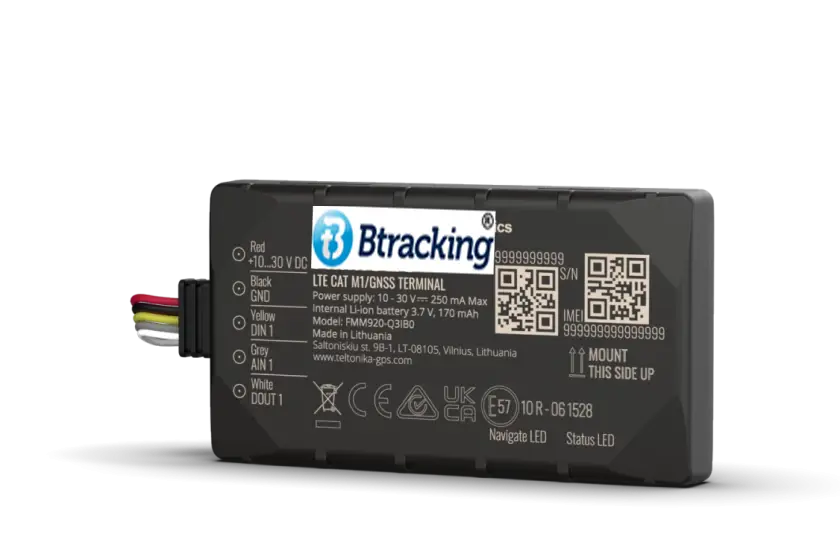
The BHW920 measures 3.0 × 1.7 × 0.5 inches, a half-inch profile that conceals in almost any panel or frame cavity. It senses ignition on/off, motion, and tilt, and supports wireless BLE sensors for add-on monitoring. Its wired I/O is limited to one digital input and one digital output, which is sufficient for a single event channel (a door sensor or a light circuit) but cannot simultaneously monitor PTO state alongside other inputs the way the BHW123 can. It operates on 12–30 V and carries an optional external cell antenna.
Consider, the right choice only where the single digital input and single digital output are sufficient and the reduced hardware cost matters; on any machine where PTO monitoring or multiple simultaneous I/O channels are required, step up to the BHW123.
BHW57P Motorcycle & ATV Tracker | Hardwired with Backup Battery: $95.99
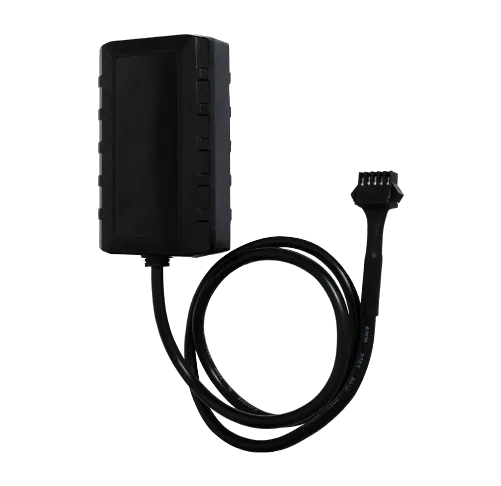
The BHW57P is built for ATVs, UTVs, and light-duty off-road equipment where waterproofing and battery independence are non-negotiable. Installation uses a five-wire in-line connector. The IP67 rating provides full dust exclusion and submersion protection. Critically for seasonal or intermittently used machines, the tracker does not draw from the vehicle battery when the vehicle is off, instead, a 1,400 mAh internal Li-Polymer backup battery sustains more than 300 hours of standby time. BLE 5.1 is on board for wireless sensor pairing, and the unit runs on LTE Cat M1/NB2 across an 8–32 V operating range.
Buy, IP67 waterproofing, zero parasitic drain on the vehicle battery, and 300+ hours of backup standby make this the correct fit for ATVs, UTVs, and any light equipment that sits unused for extended periods.
Implements, trailers, tanks and pumps left in the field
Solar and long-life battery trackers require no wired power and mount in minutes, making them the practical choice for implements, trailers, tanks, and pumps that spend most of their time stationary in a field or yard. None of these units measure fuel level, a tracker mounted on a fuel tank reports where the tank is and when it moves, nothing more.
For a broader overview of how solar asset trackers work without wiring, see the Btracking guide to solar GPS asset trackers.
BS120 Solar Powered Asset Tracker: $169.99
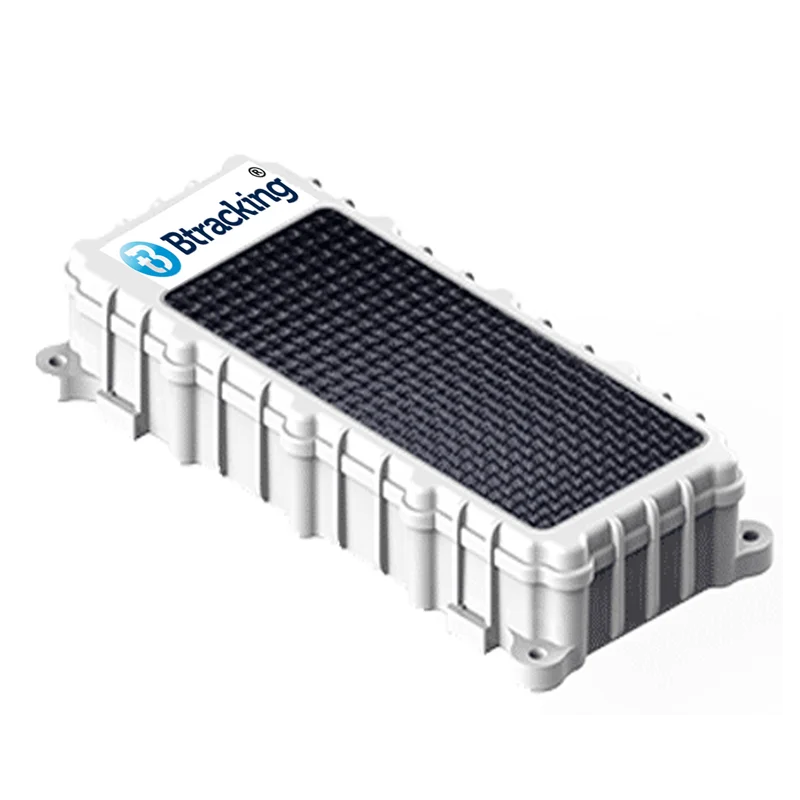
The BS120 carries a 9,600 mAh rechargeable Li-Polymer battery rated for 12+ months at 2 messages per day with no sunlight at all; with six hours of sun daily, the charge can sustain the unit for up to ten years. It mounts via magnet or screws, wakes on movement via a built-in three-axis accelerometer, and carries two light sensors, front and back, that trigger a removal alarm if the enclosure is uncovered. The IP67 enclosure handles the temperature range from −13 °F to 158 °F. The location report schedule is fully customizable.
For implements and trailers with regular sun exposure, the BS120 is the primary recommendation.
Buy, the right choice for sun-exposed implements, trailers, and containers.
BS110 Mini Solar Powered Asset Tracker: $119.99
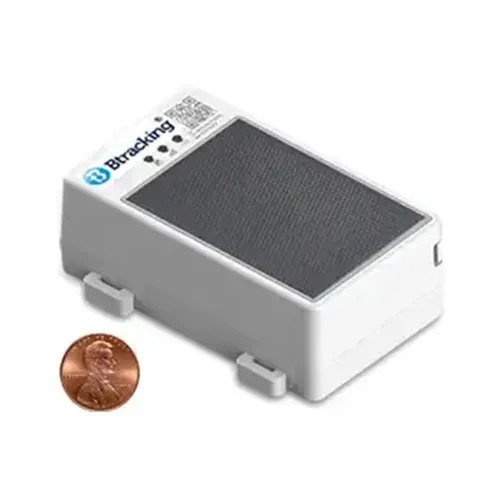
The BS110 is a smaller unit, 5.3 oz versus the BS120's 13.1 oz, with a 2,500 mAh battery. With solar input it is rated for 12+ months at 2 messages per day. Without solar, the battery life depends directly on the reporting interval the owner selects: approximately 100 days at 30-minute reporting, or approximately 45 days at 5-minute reporting. That trade-off is entirely within the operator's control via the customizable report schedule. It shares the IP67 enclosure and movement wake-up of the BS120, and its smaller form factor suits assets where mounting space is constrained.
The 2,500 mAh battery is sized for solar-supplemented operation. On a shaded or covered asset, the 45–100 day standby window may require periodic retrieval for recharging, plan accordingly before deploying it away from sunlight.
Consider, appropriate when the asset will reliably receive solar input; evaluate the standby window carefully before deploying in low-light conditions.
BB502 Trailer Asset Tracker: $189.99
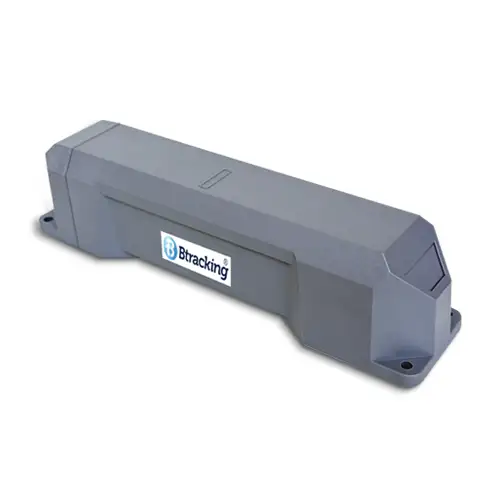
The BB502 runs on a 57,000 mAh lithium thionyl chloride battery pack rated up to 10 years and up to 16,000 messages. The battery is field-replaceable, so the unit does not need to be returned for service at end of battery life. It has an IP68 enclosure. It senses motion and tilt and increases reporting frequency when moving. An optional magnet mount kit with steel lanyard is available.
For equipment stored in sheds, under canopies, or in any location where solar recharging is not reliable, the BB502 removes the solar dependency entirely.
Buy, the right choice for shaded, covered, or enclosed locations where solar charging is unavailable.
BSX100 SolarLock Asset Tracker: $349.99
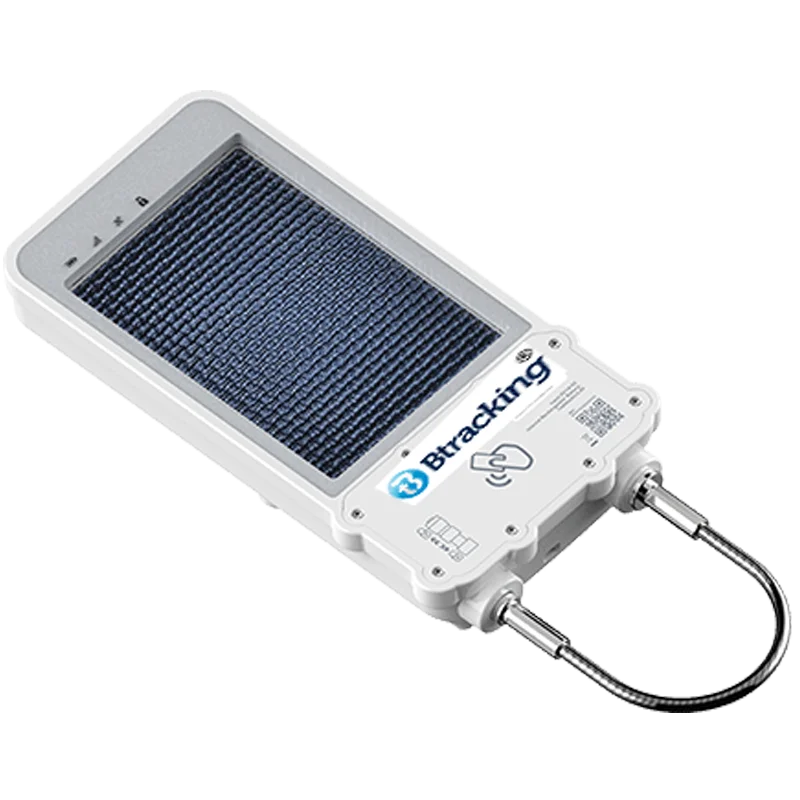
The BSX100 SolarLock combines GPS tracking with an electronic lock. It unlocks in the field via RFID card or a BLE phone app, and remotely via SMS or a platform command. Alarms fire on tampering, locking, and unlocking events. The 14,400 mAh battery is rated approximately 8–12 months on one charge with solar recharging, and the unit wakes on movement. Rope lengths from 1.4 ft to 66 ft are available, covering a range of container and trailer configurations.
At $349.99, $180 more than the BS120, the SolarLock is warranted only when the physical locking function is genuinely required. Where the objective is location and theft-movement alerts alone, the BS120 covers that need at lower cost.
Buy, but only when an electronic lock is a stated requirement; for tracking without locking, the BS120 is the more cost-efficient choice.
Which tracker for which machine
A machine that never leaves a locked shed on the home yard may not need a tracker at all; the cases below assume the asset moves off-property or is left unattended where opportunistic theft or unauthorized use is a realistic risk.
| Machine class | Tracker | Power | Stated report schedule or battery life | Price | Verdict |
|---|---|---|---|---|---|
| Pickup | BP50 Series Plugin Vehicle Tracker | OBD-II vehicle power | Every 1 min moving / every 6 hrs stopped (customizable) | $69.99 | Buy |
| Farm/grain/livestock truck | BTPLUS ProFleet Truck Tracker | Hardwired vehicle power | Every 1 min moving / every 6 hrs stopped (customizable) | $239.99 | Buy |
| Tractor or self-propelled machine | BHW123 Hardwired Vehicle Tracker | Hardwired 12/24 V | Every 1 min moving / every 6 hrs stopped (customizable) | $95.99 | Buy |
| ATV or UTV | BHW57P Motorcycle & ATV Tracker | Hardwired 8–32 V; internal 1,400 mAh Li-Polymer backup | Every 1 min moving / every 6 hrs stopped (customizable); 300+ hrs standby on backup battery | $95.99 | Buy |
| Implement or trailer in the open | BS120 Solar Powered Asset Tracker | Solar + 9,600 mAh Li-Polymer | 12+ months on single charge at 2 msg/day; up to 10 years with 6 hrs of sun a day | $169.99 | Buy |
| Tank or pump in shade or under cover | BB502 Trailer Asset Tracker | Internal 57,000 mAh replaceable Li-Thionyl Chloride | Up to 10-year / 16,000 messages; field-replaceable battery | $189.99 | Buy |
| Trailer or container that must be locked | BSX100 SolarLock Asset Tracker | Solar + 14,400 mAh Li-Polymer | 8–12 months per charge; remote or RFID/BLE unlock | $349.99 | Buy |
Solar units recharge from sunlight. On a tank or pump kept under a roof or in shade, the BS120 runs on its stored charge, rated 12+ months at 2 messages a day; the BB502's replaceable battery removes the solar dependency entirely.
Rural cellular coverage
Every Btracking unit is cellular-only, which means live data reaches the platform only where a cellular signal is present, no signal means no live update reaches the dashboard and no real-time alert is dispatched from that location.
That constraint has practical consequences worth mapping before deployment:
- BTPLUS ProFleet Truck Tracker and BTSTX ProFleet Truck Tracker, 5,000-event store-and-forward buffer. Both units log up to 5,000 events internally when out of coverage and transmit the full record automatically once a signal is re-established. The trip history is preserved, but any alert that would have fired during the dead zone (geofence breach, ignition event, engine fault) is not delivered in real time; it arrives only after the vehicle returns to coverage.
- BHW123 Hardwired Vehicle Tracker (2,000-message buffer; BP50 Series Plugin Vehicle Tracker) 1,000-message buffer. Both figures are listed in the hardware specifications. Store-and-forward behavior for these units is not separately documented here.
- Theft alerts cannot be raised in real time from a location with no signal. A tracker that is moved through or left in a coverage gap will not transmit a live alert until it re-enters the cellular network, regardless of buffer capacity.
- Pre-order coverage review. Btracking engineers review specific field and storage locations and advise on coverage before an order is placed, which is the recommended step for any site where signal availability is uncertain.
A vehicle or asset held in a no-signal area will not trigger real-time theft or geofence alerts for the duration of the outage. Buffered data confirms what happened after the fact; it does not substitute for a live response.
One map for the whole operation
Every vehicle and asset tracker on a Btracking account appears on a single map. A farm running four dashcams on its produce-delivery vehicles does not manage a separate system when it adds trackers for farm trucks, trailers, and field equipment, all of it lands on the same account, the same interface, and the same map view.
Geofence alerts extend that visibility into defined geography. The platform sends entry and exit notices for any boundary drawn on the account: individual fields, parcels of rented ground, a contractor's yard, or the home operation. When a trailer leaves a leased field, or a truck arrives at the home yard, the account receives the entry or exit notice automatically.
The farm case study illustrates how the account grows without friction. The operation starts with dashcams on the vehicles that run public roads every day, capturing recorded video from the trucks carrying its produce. As the need arises, trackers for farm trucks, trailers, and equipment are added to the same account. The added trackers sit on the same account as the dashcams.
On commercial terms, service is month to month with no contract. Cancellation requires 10 business days' notice. Btracking hardware carries a lifetime warranty for as long as the subscription remains active. Support is handled by U.S.-based engineers. Pricing is published openly; the Standard subscription starts at $12.95 per month per device on a purchased tracker. For a fuller breakdown of what fleet GPS actually costs at different fleet sizes, see the Btracking cost guide.
The lifetime hardware warranty applies while the subscription is active. Cancelling service ends warranty coverage on that device.
Frequently asked questions
Will a GPS tracker work in a field with no cell signal?
All Btracking devices are cellular and report only where a signal is available. The BTPLUS and BTSTX gateways store up to 5,000 events and transmit them when coverage returns, preserving the trip record. A tracker cannot deliver a live theft alert from a location with no signal. Btracking engineers review specific field locations before an order.
What GPS tracker should I put on a tractor?
The BHW123 Hardwired Vehicle Tracker ($95.99) is the recommended choice: it wires to power and ignition and its two digital inputs can monitor PTO on/off in addition to other events. The BHW920 ($59.99) is a simpler alternative where the additional I/O capability of the BHW123 will not be used.
Can I track an ATV or UTV on the farm?
Yes. The BHW57P Motorcycle & ATV Tracker ($95.99) is designed for this application. It installs with a five-wire in-line connector, is rated IP67 waterproof, and carries a 1,400 mAh backup battery with more than 300 hours standby time so it does not drain the vehicle battery when the ATV is parked.
Do solar trackers on implements need charging?
Solar trackers recharge from sunlight during normal field use. The BS120, for example, is rated 12+ months on a single full charge even with no sunlight at 2 messages per day. Reporting frequency is the trade-off the owner controls: more frequent reporting draws the battery faster when solar input is low.
Does a farm GPS tracker do auto-steer or yield mapping?
No. Btracking devices report location, movement, ignition state and wired input events. They are not guidance, auto-steer, section-control or yield-mapping systems. Those functions are separate precision-agriculture product categories.
Can I track a fuel tank or pump left in a remote paddock?
A solar or battery asset tracker such as the BS120 or BB502 can be mounted on a fuel tank and will report the tank's location and any movement. It does not measure the fuel level inside the tank. The BS120 adds a light-sensor removal alarm as a theft deterrent.
Products in this guide
BHW57P Motorcycle & ATV Tracker
$95.99
BHW123 Hardwired Vehicle Tracker
$95.99
BHW920 Compact Hardwired Vehicle Tracker
$59.99
BTPLUS ProFleet Truck Tracker
$239.99
BTSTX ProFleet Truck Tracker
$219.99
BP304 Deluxe Plugin Vehicle Tracker
$159.99
BP50 Series Plugin Vehicle Tracker
$69.99
BSX100 SolarLock Asset Tracker
$349.99
BS120 Solar Powered Asset Tracker
$169.99
BS110 Mini Solar Powered Asset Tracker
$119.99
BB502 Trailer Asset Tracker
$189.99
Get a written quote
Tell us what you run. An engineer confirms the details and prices it.
Request a quote